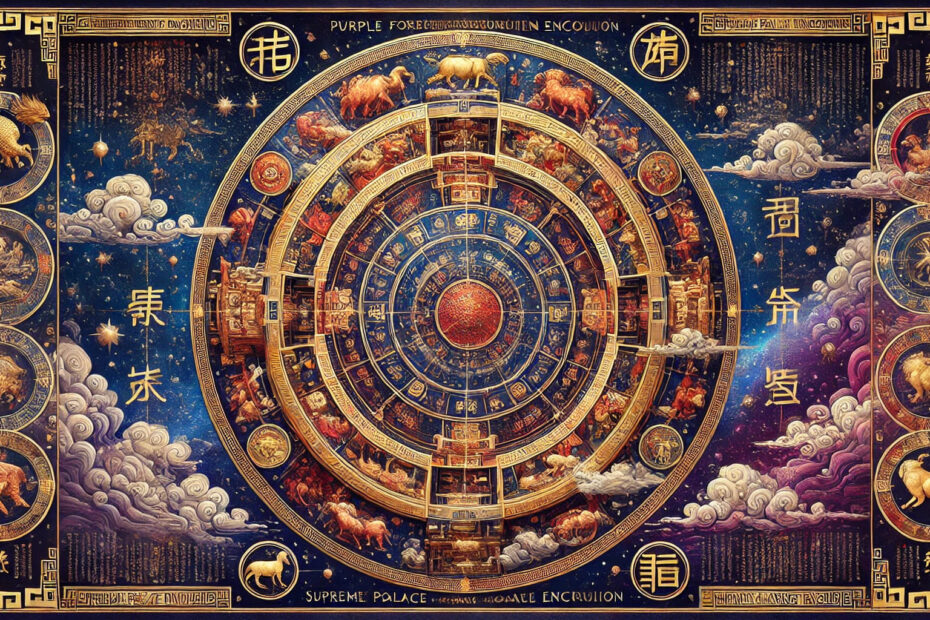
The Chinese Zodiac, deeply embedded in Eastern culture and astrology, offers a fascinating contrast to the Western Zodiac. While the Western system is based on constellations along the ecliptic plane, the Chinese approach integrates a rich tradition of astronomical observation and symbolic meaning. Here’s a deeper dive into this intricate system.
A Distinct Celestial Framework
Unlike the Zodiac constellations of Western Asia and Europe, the Chinese system divides the sky into Three Enclosures (三垣, sān yuán) and Twenty-Eight Mansions (二十八宿, èrshíbā xiù) within twelve celestial regions known as Ci (十二次). This division reflects the ancient Chinese understanding of the heavens, which emphasized harmony, cycles, and the relationships between celestial and earthly phenomena.
- Three Enclosures:
- These represent vast regions of the sky that encompass stars and constellations.
- They include the Purple Forbidden Enclosure (紫微垣, zǐwēi yuán), the Supreme Palace Enclosure (太微垣, tàiwēi yuán), and the Heavenly Market Enclosure (天市垣, tiānshì yuán).
- Twenty-Eight Mansions:
- The mansions act as a lunar-based system dividing the ecliptic path into 28 segments, similar to lunar stations in other cultures.
- Each mansion is associated with specific constellations and corresponds to different elements, seasons, and auspicious or inauspicious influences.
- Twelve Ci (次):
- These are divisions within the Three Enclosures and Twenty-Eight Mansions, functioning similarly to the Western Zodiac signs but rooted in unique Eastern astronomical principles.
The 12 Animal Signs of the Chinese Zodiac
Layered onto this celestial framework are the twelve animal signs of the Chinese Zodiac, which operate on a 12-year cycle tied to the lunar calendar. Each year is represented by an animal, and these animals are linked to the Five Elements (Wood, Fire, Earth, Metal, Water) and the Yin-Yang duality. The cycle follows this sequence:
- Rat (子, Zǐ)
- Ox (丑, Chǒu)
- Tiger (寅, Yín)
- Rabbit (卯, Mǎo)
- Dragon (辰, Chén)
- Snake (巳, Sì)
- Horse (午, Wǔ)
- Goat (未, Wèi)
- Monkey (申, Shēn)
- Rooster (酉, Yǒu)
- Dog (戌, Xū)
- Pig (亥, Hài)
Astrological Insights
The Chinese Zodiac blends astronomy, philosophy, and mythology:
- The animal signs determine personality traits and compatibility.
- The Twenty-Eight Mansions influence daily predictions and determine auspicious timings.
- The Three Enclosures and Ci highlight broader cosmic influences, reflecting the dynamic interplay between the heavens and human life.
Modern Relevance
Today, the Chinese Zodiac continues to guide practices such as feng shui, matchmaking, and annual predictions. It serves as a bridge between traditional wisdom and contemporary culture, showcasing the enduring appeal of astrology in understanding the universe and our place within it.